Man Talk may earn a commission when you buy through links on this page. That never changes what gets recommended, and it never changes the price you pay.
Logitech G29 vs Moza R5: Which Wheel Wins?
The Logitech G29 vs Moza R5 question comes down to one trade. The G29 costs around $230 on sale and works on PlayStation and PC. The Moza R5 bundle costs around $400 to $440, runs on PC only, and delivers force feedback the G29 cannot approach. For PC racers who can afford it, the R5 is the better wheel and the better long-term investment. For PlayStation owners, the R5 is not an option at all, so the G29 wins by default. That is the direct answer. The rest of the decision lives in the details. Drive technology, pedal quality, bundle contents, and upgrade paths separate these wheels in ways spec sheets hide. This guide compares them point by point, using published specifications and documented community consensus rather than marketing claims. It also names the buyers who should skip the popular pick. By the end, the right wheel for your platform, budget, and ambitions should be obvious. Prices in this class move weekly, so treat every figure here as approximate.
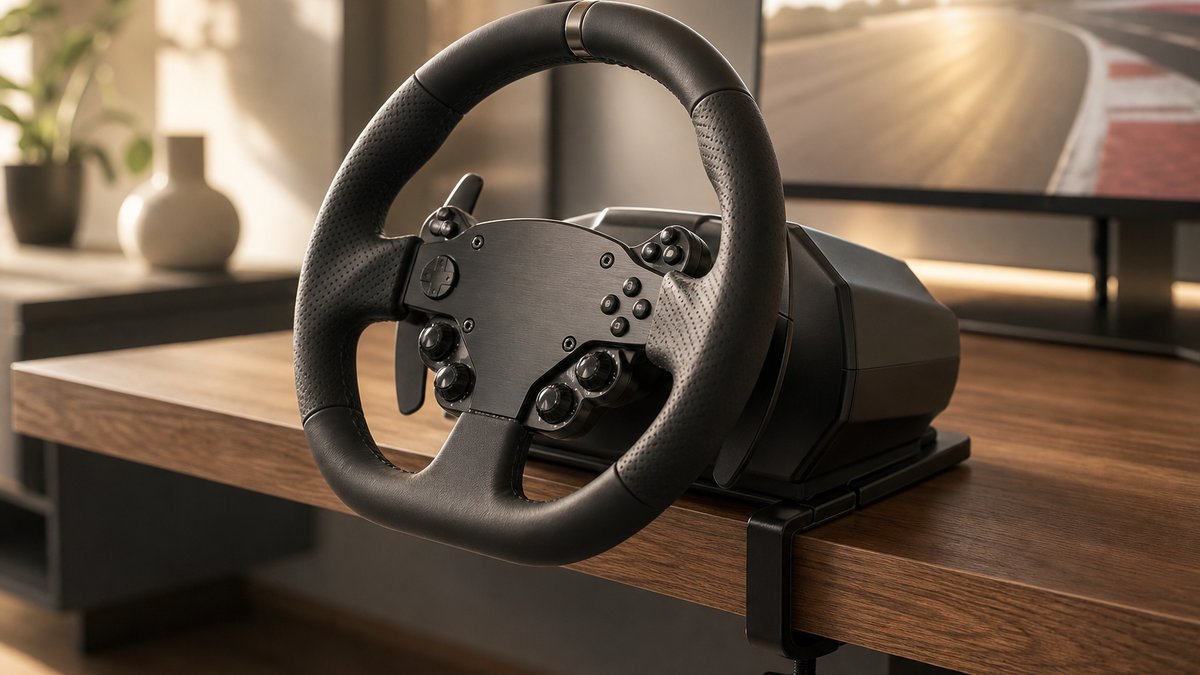
The verdict in one table
The Moza R5 is the better wheel, and the Logitech G29 is the better bargain with wider platform reach. The R5's direct drive motor outputs 5.5Nm of peak torque against roughly 2.3Nm from the G29's gears. The G29 answers with PlayStation support, a clutch pedal, and a street price near $230.
| Spec | Logitech G29 | Moza R5 bundle |
|---|---|---|
| Typical price | ~$230 on sale, $329 list | ~$400 to $440 |
| Drive system | Gear-driven, dual motor | Direct drive |
| Peak torque | ~2.1 to 2.3Nm | 5.5Nm |
| Platforms | PS3, PS4, PS5, PC | PC only |
| Max rotation | 900 degrees | 2,700 degrees |
| Pedals included | Three, with clutch | Two, Hall sensor |
| Rim | 11-inch leather, fixed | 11-inch ES, quick release |
| First released | 2015 | 2022 |
| Upgrade path | None, replace everything | Full Moza ecosystem |
Prices on both sides move constantly. The G29 has been discounted on a near-monthly cycle for years, since the hardware launched back in 2015. The R5 bundle dipped to $399.99 in United States retail promotions during 2026. Treat every number above as a typical street price, not a quote. Man Talk staff bring decades of combined gaming experience, including years spent on racing simulators.
Gear drive against direct drive
The G29 creates force feedback with two motors driving the wheel shaft through helical gears. The R5 mounts the wheel shaft directly on a single strong motor. That one design difference explains most of what separates these wheels in feel, noise, and detail.
Gears exist in the G29 for one reason: cost. Two small motors drive the shaft through helical gearing, which multiplies their modest force into usable feedback. The design was clever in 2015, and it still works. It also has known side effects. Gear lash creates a small dead zone at center, and the mechanism rattles audibly over curbs.
The R5 removes the middleman. Its motor turns the shaft directly, with a 15-bit encoder reading position and a 1000Hz USB connection reporting it. Moza's published specifications list both figures. The result is force feedback with no notchiness, near-silent operation, and far finer detail.
Noise deserves a mention of its own. Gear-driven wheels transmit a ratcheting clatter through the desk during curb strikes and crashes. Owners in shared apartments bring this up constantly in community threads. The R5's direct drive motor runs close to silent, with only pedal noise left. For late-night racers, that difference alone has justified the price gap.
What does the difference actually feel like?
Owner reports describe it the same way across forums and reviews. The G29 communicates the big events: crashes, heavy curbs, strong self-centering. The R5 adds the small ones: tire scrub at the limit, weight transfer, surface texture, the exact moment grip returns. Sim racers who switch describe gear-driven feel as an approximation and direct drive as information. That consensus comes from community testing, not from lab claims.
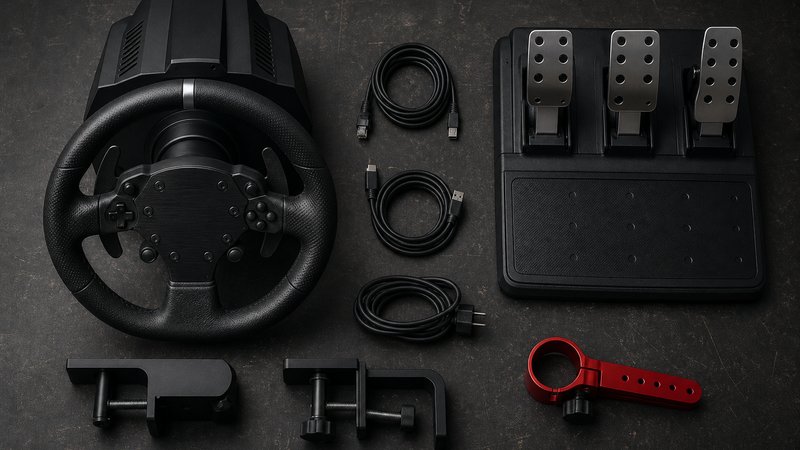
Force feedback strength: 2.3Nm against 5.5Nm
The Moza R5 more than doubles the G29's force feedback strength. Independent measurements put the G29's gear system between 2.1 and 2.3Nm at peak. Moza rates the R5 at 5.5Nm of peak torque on its official spec sheet, and it holds force more consistently.
Torque measures how hard the wheel can push back against your hands. The gap matters for two reasons. First, stronger feedback lets a sim portray heavy cars, high downforce, and kickback convincingly. Second, weak motors clip. Clipping happens when the requested force exceeds what the motor can produce, so every detail above that ceiling disappears.
The G29 clips constantly in demanding titles, which is why its feedback flattens out in fast corners. The R5 rarely reaches its ceiling at sensible settings, so the detail survives. One practical warning applies: 5.5Nm will shake a flimsy desk. The included clamp is solid, but the surface under it matters. Owners with light desks report reinforcing them or moving to a rig.
Console support settles it for many buyers
The Logitech G29 carries a PlayStation license and works on PS3, PS4, PS5, and PC. The Moza R5 works on Windows PC only. Moza's official spec sheet lists PC as the sole platform, and no firmware update changes that.
Console support is a licensing business, not a technical one. Logitech pays for PlayStation certification, and the G29 has carried it since the PS4 era. Xbox owners get the same hardware as the G920, and the newer G923 covers both console families in separate versions. Current platform lists are published at the Logitech G site.
Moza sells no console-licensed wheel in this class. The R5 spec sheet lists one platform, and that platform is PC. No adapter or firmware trick changes it in a supported way. For a PlayStation-only racer, the comparison ends here.
The licensing gap also shapes resale. PlayStation-licensed wheels hold steady demand from console owners with few options, which supports used G29 prices. Used R5 bundles trade among PC racers only, though interest in direct drive keeps them moving. Check completed listings before assuming either wheel dumps its value.
What if you race on both PC and console?
The G29 becomes the rational pick, since one wheel then covers every machine you own. The compromise runs one direction only. A PC can host either wheel, while a console accepts only the licensed one. Some two-platform racers eventually run both, keeping the G29 on the console and the R5 on the PC. That is a later problem, and a good one to have.
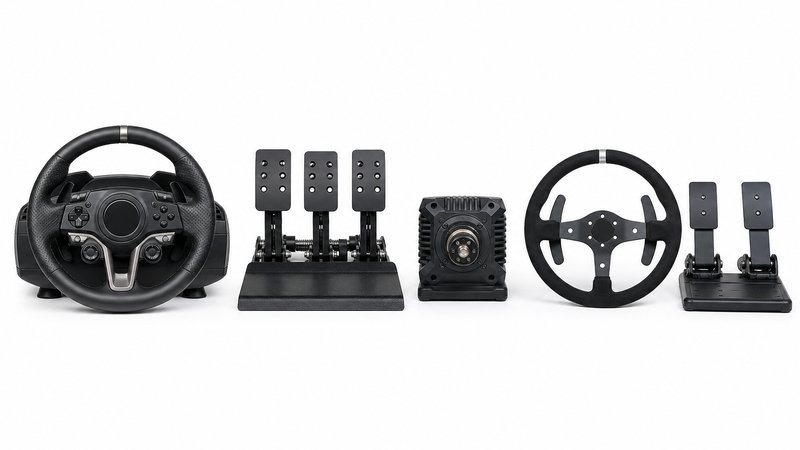
What comes in each box
Both products ship as complete starter kits with a wheel, pedals, and desk mounting. The G29 is one integrated unit with three pedals. The R5 bundle is modular: a separate wheelbase, the 11-inch ES wheel, the two-pedal SR-P Lite set, and a table clamp.
| Component | Logitech G29 | Moza R5 bundle |
|---|---|---|
| Wheelbase | Integrated with rim | R5 direct drive unit, aluminum housing |
| Rim | Hand-stitched leather, fixed | ES wheel, 22 buttons, quick release |
| Pedals | Throttle, brake, clutch | SR-P Lite throttle and brake |
| Mounting | Built-in desk clamps | Included table clamp |
| Shifter | Sold separately | Sold separately |
The full contents list on Moza's official site adds a power adapter, USB cable, and toolkit. The ES wheel carries 22 buttons, 10 RGB LEDs, and a microfiber leather grip, per that product page. The G29 counters with PlayStation-mapped console buttons on the rim. Neither box includes a shifter, so H-pattern fans budget extra on either side.
The modular design shows up in daily use too. The R5's quick release lets the rim come off in seconds, which makes storage between sessions easier. The G29 mounts and unmounts as one piece with its built-in clamps. Neither approach is difficult, but owner descriptions place the Moza hardware closer to full-size sim equipment.
Pedals: three against two
The G29 wins on pedal count, shipping throttle, brake, and clutch. The R5 bundle's SR-P Lite set wins on pedal quality, with steel construction and Hall effect sensors. Most sim racers drive with two pedals anyway, which softens Logitech's advantage.
The G29 pedals read position with potentiometers, and the brake uses a progressive spring that stiffens through its travel. The unit is plastic but usefully heavy, with a carpet grip system underneath. After a decade of service reports, the common wear points are documented: potentiometer scratchiness and spring squeak, both repairable.
The SR-P Lite set reads position with contactless Hall sensors, which avoid potentiometer wear entirely. Pedal spacing and plate height adjust with the included tools, and output curves adjust in Moza's software. The missing clutch sells as an add-on for roughly $40 to $55 depending on region. A firmer brake feel kit costs about the same.
Does the missing clutch pedal matter?
For most buyers, no. Nearly all sim racing happens with paddle shifters, where a clutch pedal sits unused. It matters for H-pattern manual driving in trucking sims, drifting, and classic car content. Anyone planning that style of driving should budget for the add-on pedal and a shifter from day one.
Software and tuning: G Hub against Pit House
Logitech's G Hub covers the basics: force strength, rotation range, and button mapping. Moza's Pit House goes much deeper, with adjustable feedback curves, pedal calibration, game-specific profiles, and firmware updates. On PlayStation, the G29 needs no software at all, which stays its simplest advantage.
Pit House is where the R5 earns part of its price. The NexGen force feedback algorithm and an iRacing 360Hz mode are both listed on Moza's product page. Users tune damping, friction, and torque limits per game, then save the results as profiles. The learning curve is real, though presets cover most popular titles well.
G Hub asks less and offers less. On PC it handles rotation and force sliders, and on console the wheel simply works once plugged in. For a racer who wants zero fiddling, that simplicity counts as a feature rather than a gap.

Longevity and the upgrade path
The G29 is a finished product with no upgrade path, because the rim, motors, and electronics form one sealed unit. The R5 is an entry into Moza's ecosystem, where the quick release accepts every Moza rim and the base drives future pedals, shifters, and handbrakes.
That framing decides long-term value. A G29 owner who outgrows the wheel replaces the whole setup at once. An R5 owner upgrades piece by piece: a formula rim, load cell pedals, a handbrake, a sequential shifter. The base itself supports a 2,700-degree maximum steering angle, which covers everything from karts to trucks.
Durability cuts the other way. The G29 has a decade-long reliability record, and community repair guides cover nearly every known failure. Moza's track record is shorter, though the R5 carries up to a 24-month warranty and regular firmware updates through the Pit House software. Gear wear and gear noise remain the G29's documented long-term weakness.
How long does each wheel actually last?
No formal failure statistics exist for either wheel, so community evidence has to serve. G29 units bought in 2015 still run today, which is a strong signal across a full decade. The known failures are worn gears, scratchy potentiometers, and frayed rim leather. The R5 has run since 2022 with few widespread failure reports. Direct drive also carries fewer moving parts to wear out, which favors it structurally over any geared design.
Price and value: what the extra $200 buys
The real-world gap is close to $200: around $230 for a discounted G29 against $400 to $440 for the R5 bundle. The extra money buys the motor, the detail, and the upgrade path. Whether that trade makes sense comes down to five questions.
- Platform. A PlayStation racer buys the G29, full stop. A PC racer keeps reading.
- Total budget. Count the add-ons. A clutch pedal or shifter moves the R5 total toward $500.
- Mounting. 5.5Nm wants a sturdy desk or a rig. A wobbly table wastes the R5's strength.
- Game library. Paddle-shift racing suits the R5 bundle as sold. Manual-clutch driving favors the G29's three pedals out of the box.
- Patience. Buyers who chase upgrades quickly should skip the G29, because its ceiling arrives fast and its resale value is modest.
Logitech lists the G29 at $329, but discounts land often enough that the sale price is the true price. The R5 bundle's $399.99 promotional price appeared repeatedly at United States retailers through 2026. The middle ground between these two includes the Moza R3 and several Thrustmaster bundles. That wider field is covered in the Man Talk guide to the best budget sim racing wheels for beginners.
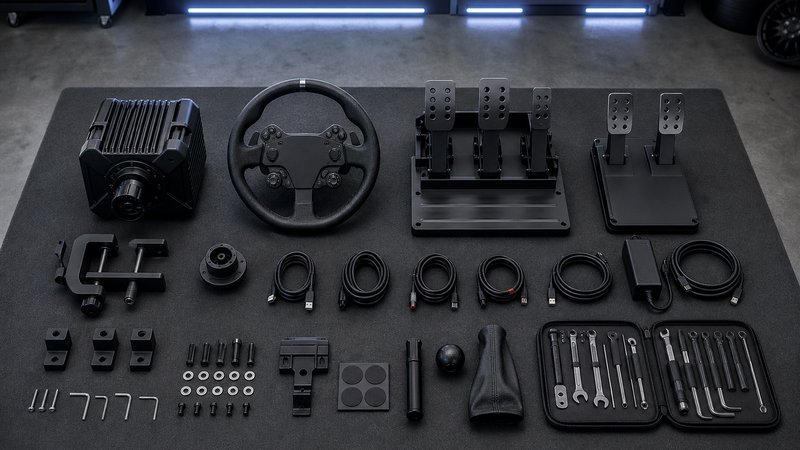
Which wheel should you buy?
Buy the Moza R5 if you race on PC and can spend around $430. Buy the Logitech G29 if you race on PlayStation, share one wheel across console and PC, or cap the budget near $230. Neither purchase is a mistake inside those lines.
Three profiles cover most shoppers. The console racer wants a wheel for Gran Turismo on a PS5, and the G29 is the straightforward answer. The value hunter wants real force feedback under $250 and accepts dated technology for the discount. The committed PC racer plans years of iRacing or Assetto Corsa, and the R5 repays that commitment. Match yourself to one of those three and the choice mostly makes itself.
The R5 is the stronger product, and community sentiment reflects it. Buyer reviews on Moza's own store run 83 percent five-star across roughly 478 ratings, and many reviewers identify as former G29 owners. The G29's endurance is its own argument. A wheel does not stay in production for over a decade without doing something right.
A full rig plan around either wheel, including stand and monitor money, is mapped in the budget sim racing setup under $600 guide. The Man Talk sim racing section tracks new bases and bundles as they release, and the about page explains how recommendations get made here.
Frequently asked questions
Does the Moza R5 work on PS5 or Xbox?
No. The R5 is a PC-only wheelbase, and Moza's spec sheet lists Windows as the sole supported platform. It has no PlayStation or Xbox license, so consoles will not recognize it. Console racers need a licensed wheel such as the G29 or G923 for PlayStation, or the G920 for Xbox.
Is the Logitech G29 still worth buying over the Moza R5?
Only in two cases. PlayStation owners have no Moza option, so the G29 remains the value pick there. Buyers capped near $230 also do fine with it. On PC with $400 available, community consensus is close to unanimous: the R5's direct drive is worth the difference.
How much stronger is the Moza R5 than the G29?
The R5 produces 5.5Nm of peak torque from a direct drive motor. The G29's gear system peaks around 2.1 to 2.3Nm in independent measurements. That is more than double the strength, and direct drive holds force more consistently, so the gap feels larger than the numbers suggest.
Can Logitech G29 pedals plug into a Moza R5 base?
Not directly. The G29 pedals use a proprietary connector made for Logitech bases, and the R5 has no port for it. Third-party USB adapters exist, and owners report mixed results. The practical route is the SR-P Lite set in the bundle, upgraded with Moza's clutch add-on if needed.