Man Talk may earn a commission when you buy through links on this page. That never changes what gets recommended, and it never changes the price you pay.
Best Sim Racing Cockpits Under $300
The best sim racing cockpit under $300 in 2026 is the Next Level Racing GT Lite Pro (around $250 to $300) for direct drive wheels. The Playseat Challenge ActiFit (around $230) is the top pick for light, fast-folding storage. The Playseat Challenge X (around $299) is the most complete foldable for belt-driven wheels. Every rig in this guide folds away or breaks down for shared living spaces. The differences show up in frame stiffness, pedal mounting, and how much wheel torque each one tolerates. That torque point trips up most first-time buyers, because a rig that feels solid with a Logitech wheel can flex under direct drive torque. This guide compares six cockpits and two wheel stands on those points. The comparisons rest on published specs and the collective judgment of the sim racing community, not marketing copy. It also covers what a sub-$300 rig genuinely cannot do. By the end you will know which rig fits your wheel, your space, and your budget. You will also know when saving another $100 is the smarter move.
The picks at a glance
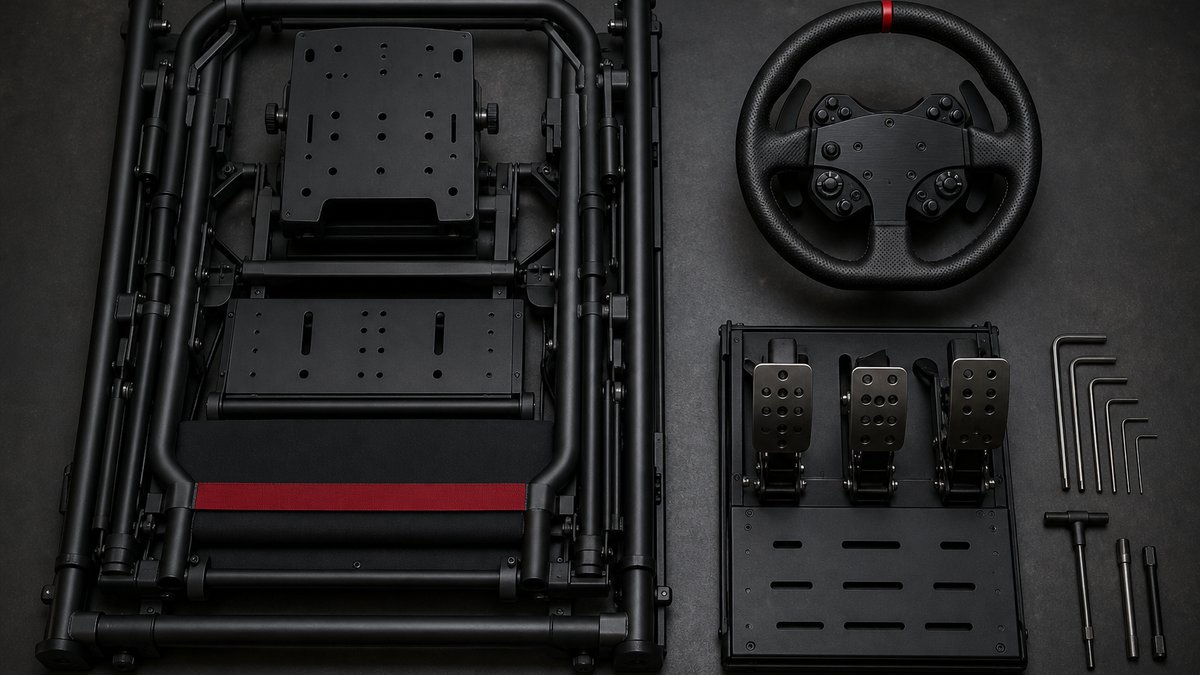
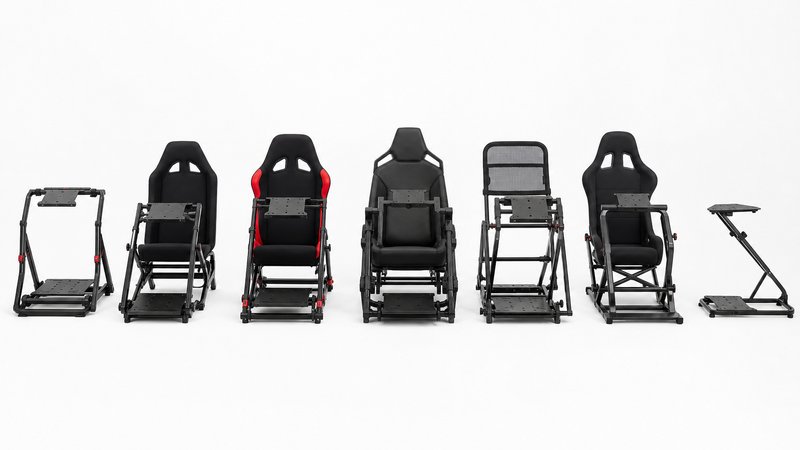
Six sim racing rigs under $300 stand out in 2026. They are the Playseat Challenge ActiFit, Playseat Challenge X, Next Level Racing GT Lite, GT Lite Pro, F-GT Lite, and the GT Omega ART frame. Two wheel stands round out the list for racers who already own a chair.
| Rig | Typical price | Best for | Folds | Wheel limit |
|---|---|---|---|---|
| Playseat Challenge ActiFit | ~$230 | Lightest fold-away | Yes, ~10 seconds | Belt drive |
| Playseat Challenge X | ~$299 | Most adjustable foldable | Yes, ~10 seconds | Belt drive |
| NLR GT Lite | ~$150-250 | Value pick on sale | Yes | Belt drive |
| NLR GT Lite Pro | ~$250-300 | Entry direct drive | Yes, on rollers | DD up to 13 Nm |
| NLR F-GT Lite | ~$250 | GT + formula positions | Yes | Belt drive |
| GT Omega ART (frame only) | ~$250 | Most rigid, add a seat | No | Strong belt drive |
Prices on these rigs swing week to week, sometimes by $50 or more. Treat the numbers above as typical street prices, not guarantees.
How these picks were chosen
Every pick had to meet four tests. The tests: an honest torque ceiling, a stable pedal mount, storage that works in real homes, and a track record in community reviews. Man Talk built this list from published specifications and the documented consensus of sim racing communities and specialist reviewers, not from paid placements.
That last point matters in this niche. Every budget rig claims to be sturdy and wobble-free. Almost none of the marketing mentions that stiffness depends on tube gauge and wheel torque. Community testing catches what spec sheets miss: pedal trays that bounce, wheel decks that rock, and frames that creep across hard floors. Where owners disagree with the marketing, this guide sides with the owners. Man Talk staff bring decades of combined gaming experience, including years spent on racing simulators. No first-person testing claims are made here. When a claim needs a source, it comes from documented owner reports and published reviews.
Why a cockpit beats a desk clamp
A cockpit fixes your seat, your wheel, and your pedals into one rigid triangle. That fixed geometry is the reason consistency improves once the desk clamp goes away.
Clamped to a desk, the wheel sits at whatever height the desk allows. The pedals float on the floor, creeping backward through every hard braking zone. The chair rolls, the distances drift, and no two sessions feel the same. A cockpit ends all of that. The seat, wheel deck, and pedal tray connect to one frame, so braking force pushes against the structure instead of sliding hardware around. Muscle memory builds faster when the controls never move.
Sim racing communities repeat the same advice for that reason: a modest wheel in a stable rig beats a strong wheel on a wobbly desk. The rig is not a luxury bolted on at the end of a setup. It is the foundation the rest of the hardware depends on.
Playseat Challenge ActiFit: the fold-away classic (~$230)
The Playseat Challenge ActiFit is the default pick for anyone who must reclaim the living room after every session. It weighs 8.5 kg, folds in roughly ten seconds, and stores nearly flat with the wheel still attached.
The ActiFit is the lightest cockpit in this guide and the fastest to put away. The knit sling seat suspends you deck-chair style, which owners describe as comfortable for sessions up to a couple of hours. Playseat rates it for drivers from 120 to 220 cm tall, with a 120 kg weight ceiling. That capacity figure is the lowest here, so heavier racers should check it first. The wheel deck comes pre-drilled for standard Logitech, Thrustmaster, and Fanatec mounts.
The weaknesses are documented. The pedal plate mounts through the fabric base, and it shifts under hard braking, per repeated owner reports. No shifter mount ships in the box; Playseat sells one separately. Strong direct drive bases are a bad match, since the light frame can tip forward under torque. With a Logitech G29 or G923, none of that matters much. As a fold-away rig for belt-driven wheels, it remains the category benchmark.
Playseat Challenge X: the complete foldable (~$299)
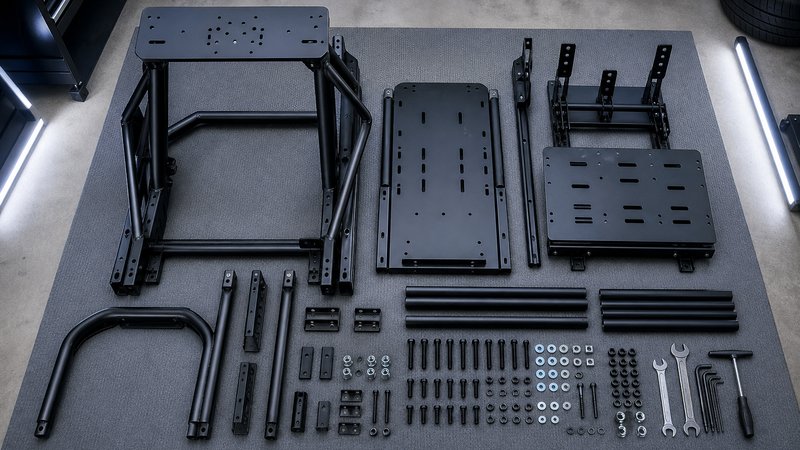
The Playseat Challenge X is the most adjustable foldable under $300 for belt-driven wheels. It adds a hinged wheel deck, six recline positions, and a standard shifter mount over the ActiFit.
The frame is high-carbon steel, and capacity jumps to 359 lb, among the highest at this price. The X-Adapt system covers six seating angles, from upright GT to a near-formula recline. The hinged wing-door wheel deck swings open, which makes getting in and out far easier than on the ActiFit. Fold-up time stays around ten seconds with the hardware attached.
The limits are familiar. The seat is still a fabric sling rather than a padded bucket. The wheel position does not adjust fore and aft, and tall drivers report feeling cramped. Playseat itself steers direct drive owners toward the sturdier Trophy, which sits above this budget. At roughly $299 the Challenge X spends the whole budget, but belt-drive racers get the most complete foldable for the money.
Next Level Racing GT Lite: the value fold (~$200 on sale)
The Next Level Racing GT Lite is the value pick whenever its price dips under $200. It pairs a hard-mounted pedal deck with the smallest folded footprint in the class, roughly 61 by 45 cm.
That hard-mounted pedal deck is the headline advantage over the Challenge ActiFit. Pedals bolt to a rigid tray connected to the frame, so braking force cannot slide them away. The rig weighs under 15 kg and collapses like a deck chair, easy to carry room to room. The backrest height adjusts through five settings, and a shifter mount ships in the box.
The compromises: the backrest angle is fixed at 105 degrees, GT position only. The single-tube wheel support shows some side-to-side play, a repeated note in reviews. Pricing is volatile, swinging between roughly $150 and $250 depending on promotions. Under $200 it is the clearest value in this guide. Near $250, the Challenge X and the GT Lite Pro both make stronger cases.
Next Level Racing GT Lite Pro: the direct drive pick (~$300)
The Next Level Racing GT Lite Pro is the only foldable under $300 rated for direct drive wheels. Next Level Racing certifies it for wheelbases up to 13 Nm, which covers the Fanatec CSL DD and Moza R5.
Released in early 2024, the Pro fixes the original GT Lite's biggest limits. The frame steps up to 25 mm powder-coated carbon steel tubing, the same gauge as the brand's mid-range rigs. The wheel deck thickens to 4 mm and tilts through 60 degrees. The seat gains real padding at the lumbar, shoulders, and thighs, plus three recline angles and five height settings. Built-in rollers make it easy to wheel aside, and the design carries an FIA license.
Reviewers still note some up-and-down wheel deck movement under direct drive load. Next Level Racing's own advice helps: strap the front and rear legs together with the included webbing during sessions. Assembly runs longer than the simpler foldables, up to about 90 minutes. For anyone running an entry direct drive base, or planning that upgrade, this is the pick.
Next Level Racing F-GT Lite: two positions, one rig (~$250)
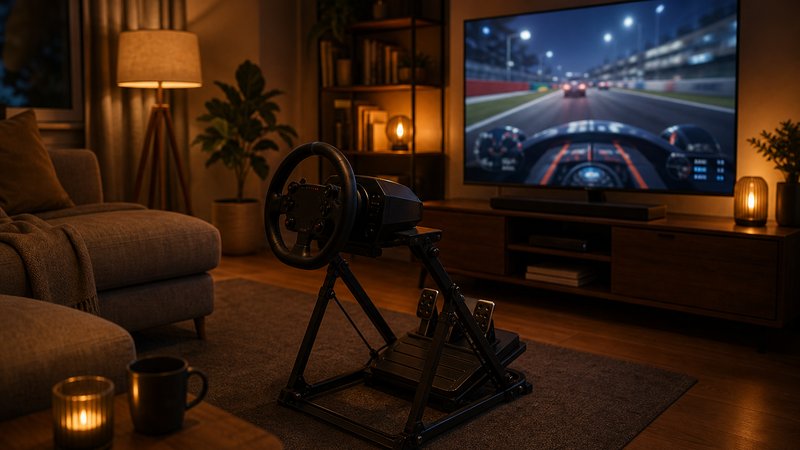
The Next Level Racing F-GT Lite is the only foldable here with both GT and formula seating positions. Racers who split their time between GT cars and open-wheel sims are the audience.
Switching positions changes the whole driving geometry, from pedal angle to arm extension. The F-GT Lite handles both through hub mounts rated at 150 kg of force each. The pedal plate is hard-mounted with sliding adjustment, and a shifter mount ships standard. The design dates to 2020, and the rig weighs about 22 kg, the heaviest foldable in this guide.
Owner sentiment runs weaker than for its siblings, mostly tied to shipping damage and quality-control complaints rather than structural failures. Assembly also takes several hours. Racers who stay in GT cars should buy the GT Lite Pro at similar money instead. The F-GT Lite earns its slot only for genuine dual-discipline drivers on belt-driven wheels.
GT Omega ART frame: the rigid upgrader's route (~$250)
The GT Omega ART is the most rigid frame under $300, and the only pick sold without a seat. It suits racers who already own a compatible seat or plan to source one separately.
Enthusiasts have trusted the ART for years because the steel frame barely moves under strong belt-driven wheels. Long-term owners run Fanatec ClubSport-class hardware and load-cell pedals on it without rigidity complaints. Everything adjusts: frame length, wheel height, pedal angle, and shifter position. Pre-drilled plates cover Fanatec, Moza, Logitech, and Thrustmaster patterns.
Two catches. The pedal plate is a single-pivot MDF board, and it can swing under load-cell braking; GT Omega sells front support bars that cure it. The seat gap is real, since adding a GT Omega seat pushes the total past $300. Stock also comes and goes, so check availability before counting on it. For a permanent setup with a seat already in hand, nothing here is stiffer.
Wheel stands: the cheaper route if you own a chair
A wheel stand is the budget route for racers who already own a good chair. The Next Level Racing Wheel Stand 2.0 (around $180) and the GT Omega APEX (under $200) lead the class.
The Wheel Stand 2.0 uses carbon steel construction and folds through a pivoting pedal deck. Reviewers running an 8 Nm Fanatec CSL DD on it report minimal flex, which is unusual for a stand. GT Omega splits its stands by torque: the PRO handles wheels up to about 5 Nm, the APEX up to 15 Nm. Both GT Omega stands fold flat with the hardware still attached. Trak Racer plays in this space as well, though its full cockpits start well above this budget.
The catch never changes. Pedals on a stand either hang from a small tray or sit loose on the floor. Under hard braking, loose pedals slide, and your body has no fixed structure to brace against. A stand plus an office chair works fine for casual racing. For anything competitive, the connected seat-and-pedal geometry of a cockpit wins.
How much torque can a $300 rig really take?
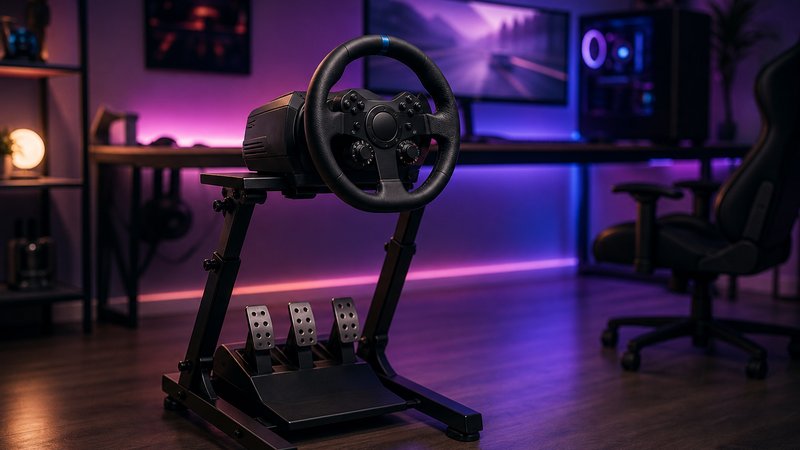
Wheel torque decides which rig survives. Belt-driven wheels below 5 Nm are safe on every pick here. Entry direct drive bases need the GT Lite Pro or a torque-rated stand. Anything above 13 Nm outgrows this budget entirely.
| Wheel class | Typical examples | Safe options in this guide |
|---|---|---|
| Belt drive, up to 5 Nm | Logitech G29/G923, Thrustmaster T300 | Every rig and stand listed |
| Entry direct drive, 5-8 Nm | Fanatec CSL DD (5 Nm), Moza R5 | GT Lite Pro, GT Omega APEX stand |
| Mid direct drive, 8-13 Nm | CSL DD with 8 Nm kit, Moza R9 | GT Lite Pro only |
| Above 13 Nm | Moza R12, ClubSport DD | None; budget for a rigid rig |
Torque ratings matter more than any other spec on this page. A wheel that overpowers its mount produces flex, and flex turns steering detail into noise. Pairing decisions start with the wheel, so settle that choice first. The Man Talk guide to the best budget sim racing wheel for beginners covers that side of the equation.
Can a foldable rig really handle a direct drive wheel?
One can, within limits. The GT Lite Pro carries a manufacturer rating up to 13 Nm, and independent reviews back it up at CSL DD strength. Every other foldable here flexes visibly once torque passes belt-drive levels. Community threads have stayed consistent on this point across years of owner reports.
What happens when the wheel overpowers the rig?
Three things, all bad. The wheel deck rocks, so force feedback detail smears into vibration. The frame can walk across hard floors during long sessions. In the worst case, a light foldable can tip forward when the driver stands up with the wheel loaded. Heavier hardware needs a heavier frame, with no exceptions.
What to check before buying any budget rig
Five checks separate a good purchase from a returned one: torque ceiling, pedal mounting, folded size, seat situation, and drill pattern compatibility.
- Torque ceiling. Match the rig rating to the wheel you own or plan to buy. A belt-driven wheel is safe everywhere here. Direct drive narrows the list to one foldable.
- Pedal mounting. Hard-mounted trays, as on the GT Lite family, hold position under braking. Fabric and pivot mounts shift, and load-cell pedals make the difference obvious.
- Folded size. Measure the closet or corner first. The GT Lite folds to roughly 61 by 45 cm, while the ActiFit stores nearly flat but longer.
- Seat situation. Sling seats dominate this price tier, and the ART ships with no seat at all. Factor a seat into the real cost before comparing prices.
- Drill patterns. Confirm the wheel deck is pre-drilled for your brand. Logitech, Thrustmaster, Fanatec, and Moza patterns are standard on every rig here, but checking takes a minute.
One more habit worth copying from experienced buyers: read recent owner reviews, not just launch-week coverage. Budget rigs get quiet hardware revisions, and a flaw fixed in 2024 may not match the unit shipping today. Ten minutes in current owner threads catches those changes before the order goes in.
Which one should you actually buy?
Buy the Challenge ActiFit if fold-away weight matters most. Buy the Challenge X for the most adjustable belt-drive foldable. Buy the GT Lite on sale for value, the GT Lite Pro for direct drive, and the ART frame for a permanent rig.
A simpler way to decide: match the rig to the strongest wheel you expect to own within two years. Racers settled on a Logitech or Thrustmaster belt-driven wheel can buy on price and storage needs alone. Racers eyeing a direct drive upgrade should buy the GT Lite Pro now and avoid paying twice. Racers with a dedicated room and a spare seat should wait for ART stock.
Console racers get one more nudge. Every rig here works with PlayStation and Xbox wheels the same way it works on PC, since mounting is purely mechanical. The deciding factor stays the wheel, not the platform. Pick the rig for the hardware bolted to it, and the console side takes care of itself.
Is it worth stretching past $300?
Sometimes, and the cases are specific. The Playseat Trophy adds a genuinely direct-drive-ready folding frame at roughly $399. Rigid static rigs from Trak Racer and the aluminum-profile brands start around $500 before a seat. For belt-driven wheels, spending more buys comfort rather than lap time. For wheels near 15 Nm and beyond, spending more is simply required.
The sub-$300 rig does one job well: it replaces the desk clamp with a fixed, repeatable driving position. The Man Talk sim racing section tracks new gear and follow-up guides as they publish, and the about page explains how recommendations get made here. Manufacturer spec sheets are published at Next Level Racing's official site and the official Playseat store.
Frequently asked questions
Can a cockpit under $300 handle a direct drive wheel?
One rig in this class carries an official direct drive rating. The Next Level Racing GT Lite Pro is rated for direct drive wheelbases up to 13 Nm. That covers the Fanatec CSL DD and the Moza R5. Every other foldable here is built for belt-driven wheels and flexes under strong direct drive torque.
Is a wheel stand or a cockpit better for a small apartment?
A cockpit is the better buy for most small apartments, despite the extra bulk. A stand holds only the wheel, so pedals sit loose on the floor and slide under braking. Folding rigs like the GT Lite collapse to roughly 61 by 45 cm. That fits a closet corner.
Do budget sim racing cockpits come with a seat?
Most of them do, though seat quality varies widely at this price. The Playseat Challenge models and the Next Level Racing Lite rigs use fabric sling seats, not padded buckets. The GT Omega ART is the exception, shipping as a bare frame. Budget for a separate seat if you choose it.
Will a foldable cockpit wobble during racing?
Some flex is unavoidable at this price, and marketing that claims otherwise is wrong. The usual culprits are single-tube wheel supports and pivoting pedal plates. The GT Lite Pro flexes least among foldables, thanks to 25 mm steel tubing and strap bracing. Belt-driven wheels keep every rig here well behaved.