Man Talk may earn a commission when you buy through links on this page. That never changes what gets recommended, and it never changes the price you pay.
Best Atari 2600 Games Ranked: The Top 20
The best Atari 2600 games are Pitfall, Adventure, Yars' Revenge, River Raid, and Missile Command, in that order. Those five lead a ranking of twenty cartridges that still reward a player in 2026. The full list spans the console's whole life, from the 1977 launch lineup to its strange 1986 afterlife. Every entry names its year, its developer, and the reason it beats its neighbors. Playability today counted for more than fame back then, and the order reflects that choice. Man Talk staff started on Coleco and Atari consoles when those machines were new, so the memories here are firsthand. The judgments rest on how each game feels under a modern thumb, not on nostalgia alone. Expect Activision cartridges to place high, because the programmers who founded that company in 1979 outclassed nearly everyone. Expect a few sacred cows to land lower than usual, with reasons given. The guide ends with every legal route to these games, from the Atari 50 collection to new-production cartridges for the 2600+ console.
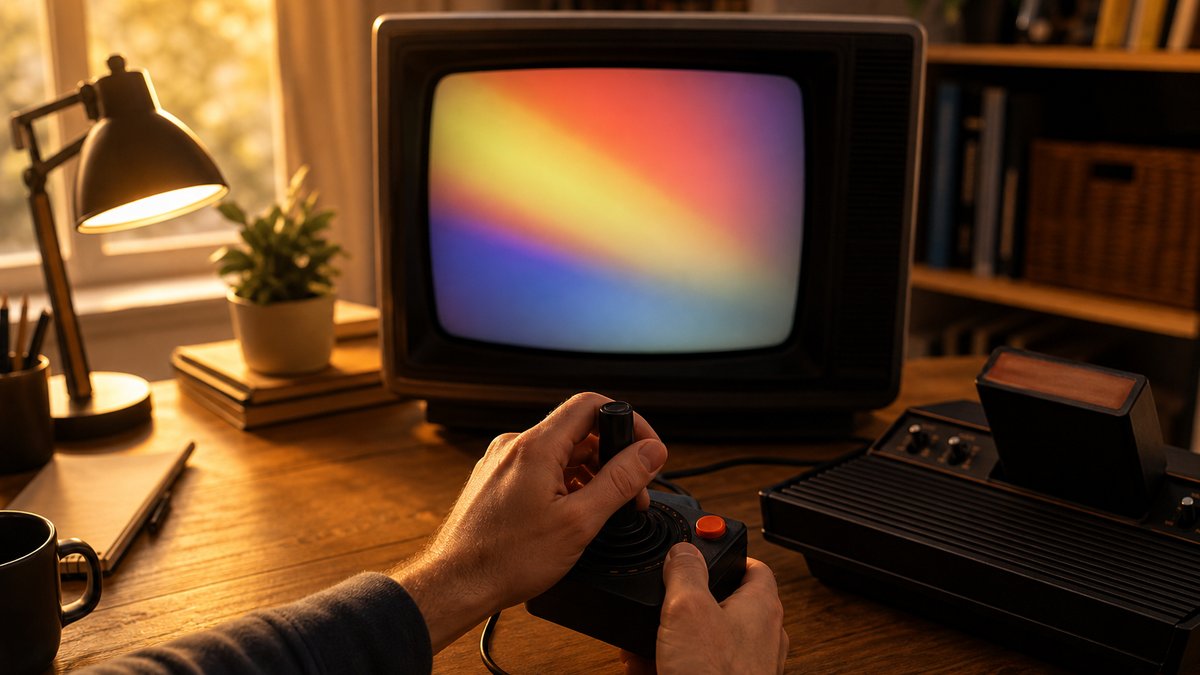
The full ranking, 1 through 20
Twenty cartridges made the cut from a library of roughly 500 official releases. Pitfall leads, the 1977 pack-in Combat lands at sixteen, and the 1986 technical showcase Solaris holds fourteen. Here is the complete order.
- Pitfall (Activision, 1982). Four million sold and still the console's high-water mark.
- Adventure (Atari, 1980). The first action-adventure game, hidden Easter egg included.
- Yars' Revenge (Atari, 1982). Atari's best-selling original for the system.
- River Raid (Activision, 1982). Carol Shaw's endless river, generated from 4K of code.
- Missile Command (Atari, 1981). Cold War dread with a joystick.
- Space Invaders (Atari, 1980). The first licensed arcade port on any console.
- Asteroids (Atari, 1981). The first 8K bank-switched cartridge.
- Kaboom (Activision, 1981). The paddle controller's finest hour.
- H.E.R.O. (Activision, 1984). Late-era rescue design that still feels modern.
- Demon Attack (Imagic, 1982). The prettiest shooter on the machine.
- Warlords (Atari, 1981). Four paddles, one legendary party game.
- Frogger (Parker Brothers, 1982). The port that made a board game company a video game player.
- Enduro (Activision, 1983). Day, night, fog, and ice inside 4K.
- Solaris (Atari, 1986). The console's technical peak, nine years after launch.
- Ms. Pac-Man (Atari, 1983). The apology for 1982's Pac-Man, and a good one.
- Combat (Atari, 1977). The pack-in that launched a thousand sibling rivalries.
- Berzerk (Atari, 1982). Robot mazes minus the arcade's taunting voice.
- Keystone Kapers (Activision, 1983). A cop chase through a department store.
- Megamania (Activision, 1982). A shooter about hallucinated hamburgers.
- Haunted House (Atari, 1982). The ancestor of every horror game.
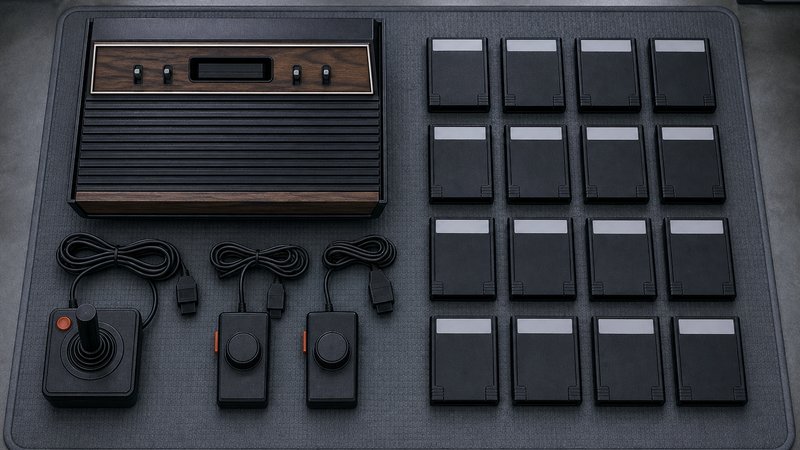
How this ranking was decided
Four tests decided every placement. The tests: play quality in 2026, honest use of the hardware, historical footprint, and legal availability today. Fun now beats famous then, at every position.
The machine these designers targeted had 128 bytes of RAM and no real video memory. The programmer drew each frame line by line, racing the television's electron beam down the screen. Every good game on this hardware is a small miracle of budgeting. That context separates clever design from lucky design, and the ranking rewards the clever kind. The console sold about 30 million units between its 1977 launch at $189.95 and its 1992 retirement. It launched as the Atari Video Computer System and only became the 2600 in 1982, named for part number CX2600. No per-cartridge testing claims appear here beyond the staff's collective decades with the hardware. Where a claim needs a source, it comes from documented sales figures and published histories.
Why do Activision cartridges rank so high?
Because the people who founded Activision wrote the book on this hardware. David Crane, Larry Kaplan, Alan Miller, and Bob Whitehead programmed many of Atari's early hits, then left over credit and royalties in 1979. Atari sued in 1980, and the settlement had Activision pay a licensing fee per game. That deal made Activision the first third-party console developer and created the licensing model consoles still use. The four kept pushing the machine harder than Atari did, and buyers noticed. By 1982, third-party games accounted for half of all 2600 game sales. Seven of the twenty games below wear the Activision label, and each earned its spot on play, not sentiment.
1. Pitfall (Activision, 1982)
Pitfall is the best Atari 2600 game ever released. David Crane's jungle runner sold more than four million cartridges and topped sales charts for over a year. Pitfall Harry became the console's first real star.
Crane fit 255 connected jungle screens into a 4K cartridge. The player gets 20 minutes to grab 32 treasures while crocodiles, scorpions, rolling logs, and tar pits object. The vine swing, complete with its Tarzan yell, remains one of gaming's great physical sensations. What holds up is the risk math. Underground tunnels move Harry faster but punish mistakes harder, so every screen asks a clean question about greed. Activision mailed an Explorers Club patch to players who sent photo proof of a 20,000 point run. Thousands of Polaroids of television screens arrived, an early achievement system run through the postal service.
2. Adventure (Atari, 1980)
Adventure invented the action-adventure genre. Warren Robinett turned a text game concept into a world of castles, keys, and dragons, all drawn in moving graphics for the first time.
Robinett adapted the mainframe text game Colossal Cave Adventure into pure graphics, against his manager's advice. The result sold about a million copies. Three dragons guard the world, each one famously shaped more like a duck than a lizard. A bat steals items at the worst possible moments, an early taste of emergent chaos. The whole world runs from a 4K ROM and 128 bytes of RAM. Hidden inside sits the famous secret room bearing Robinett's name, his answer to Atari's no-credit policy. Slow by modern standards, the game still produces real dread when Rhindle closes in with the player's key out of reach.
3. Yars' Revenge (Atari, 1982)
Yars' Revenge is the best-selling original game Atari ever made for the 2600. Howard Scott Warshaw built it in 1982 after a licensed Star Castle port proved unworkable on the hardware.
The player is a mutant housefly gnawing through a shield to expose the Qotile behind it. One cannon shot wins the round, and standing in its path loses everything. The shimmering neutral zone down the screen's center is the game's own program code, drawn as colored static. That trick turned a memory limitation into the most distinctive visual on the console. A comic book in the box explained the strange backstory, an early piece of transmedia. Warshaw's next assignment became infamous. Atari gave him about six weeks to build E.T., manufactured roughly four million cartridges, and sold about 1.5 million.
4. River Raid (Activision, 1982)
River Raid is the finest shooter on the console. Carol Shaw's 1982 vertical scroller squeezed a seemingly endless river into 4K by generating the terrain from an algorithm instead of a stored map.
The jet flies up an unbroken river, threading islands while shooting ships, helicopters, and bridges. Fuel forces constant risk decisions, because refueling means slowing down over depots while targets keep coming. That single mechanic gives the shooting a strategic spine most arcade games lacked. Shaw, one of the first women to design commercial video games, produced a million seller with it. The game earned a stranger honor in 1984. West Germany's youth media office placed it on its restricted index, a first for any video game. Every vertical shooter since flies in this cartridge's shadow.
5. Missile Command (Atari, 1981)
Missile Command brought 1980's scariest arcade game home in 1981. Rob Fulop's port swapped the arcade trackball for the standard joystick and lost almost nothing in the move.
Six cities sit at the bottom of the screen, and warheads rain down until they are gone. There is no winning, only lasting longer, which made the Cold War subtext impossible to miss. Arcade designer Dave Theurer said the game gave him recurring nightmares of real missile strikes. Fulop's home version sold in the millions and became one of the console's essential cartridges. Atari's holiday reward for that work was reportedly a coupon for a free turkey. Fulop left for the startup Imagic soon after and wrote Demon Attack, ranked tenth here. The screen-clearing panic of the final seconds still lands in 2026.
6. Space Invaders (Atari, 1980)
Space Invaders turned the console into a phenomenon. The 1980 release was the first officially licensed arcade port on any home system, and it nearly doubled Atari's installed base within the year.
Atari licensed Taito's 1978 arcade hit and handed the port to programmer Rick Maurer. The move rewrote the industry's economics. Atari sold 1.25 million Space Invaders cartridges in 1980 alongside more than a million consoles. People bought the hardware to get the game, the first clear system-seller in console history. Maurer's version added 112 variations, including invisible invaders and shields that drift across the screen. The core loop needs no defense: rows descend, the tempo rises, and the last invader sprints. Later shooters on this list play better, which is why a historic giant sits sixth.
Ranks 7 through 12: arcade fire and paddle kings
Six games hold the middle of the ranking: Asteroids, Kaboom, H.E.R.O., Demon Attack, Warlords, and Frogger. Each one either brought an arcade hit home honestly or built something the arcades never offered.
7. Asteroids (Atari, 1981). Brad Stewart's port was the first 2600 cartridge to use bank switching, doubling storage to 8K. The extra room bought 66 game variations and the arcade's full loop of drift, thrust, and panic. Atari sold millions of copies, and the hyperspace button still feels like a prayer.
8. Kaboom (Activision, 1981). Larry Kaplan's bomb-catching game sold more than a million cartridges and made the paddle controller essential. Buckets shrink as the Mad Bomber speeds up, and past 1,000 points the game becomes pure nervous system. No cartridge on the console generates more sweat per minute.
9. H.E.R.O. (Activision, 1984). John Van Ryzin sent players into collapsed mineshafts with a helicopter backpack, a laser helmet, and dynamite. The rescue structure, with a trapped miner waiting at the bottom of each shaft, reads like a modern indie game. It arrived in 1984, as the market collapsed, and deserved a far bigger audience.
10. Demon Attack (Imagic, 1982). Rob Fulop landed at Imagic, a startup stacked with former Atari programmers, and wrote its signature hit. Winged demons split, dive, and pulse with color cycling that still looks expensive. Imagic rode it to some of the best sales of the era outside Atari and Activision.
11. Warlords (Atari, 1981). Four paddle controllers plug in, four castles appear, and friendships end. Carla Meninsky's take on the arcade game turned Breakout into a four-player siege. It remains the best party game the console ever had, and one of the best of its decade.
12. Frogger (Parker Brothers, 1982). The board game giant bought home rights to Konami's arcade hit and delivered a genuinely faithful port. It sold in the millions and proved the license gold rush could produce craft as well as shovelware. Traffic still kills, logs still sink, and one more try still beckons.
Ranks 13 through 16: deep cuts and the founding father
Four games fill the next tier: Enduro, Solaris, Ms. Pac-Man, and Combat. Two are technical marvels, one is a public apology done right, and one started everything in 1977.
13. Enduro (Activision, 1983). Larry Miller built a racer with a day-night cycle, fog banks, and icy roads, all inside 4K. Pass 200 cars before the first day ends or the run is over. The sunrise after a long night stretch was a genuine goosebump moment in 1983.
14. Solaris (Atari, 1986). Doug Neubauer, creator of Star Raiders, delivered the console's technical peak nine years after the hardware shipped. A full galactic map, planet rescues, and warp travel run on those same 128 bytes of RAM. Late-era 2600 releases rarely found an audience, and this one deserved better.
15. Ms. Pac-Man (Atari, 1983). The 1982 Pac-Man port was rushed and flickery, yet still sold more than seven million copies. Atari answered a year later with a version that got the mazes, the movement, and the feel right. It stands as proof the hardware was never the real problem.
16. Combat (Atari, 1977). One of nine launch cartridges, and the one packed in with the console itself. Its 27 variations of tank and biplane duels defined living-room warfare for a generation. Nearly fifty years later, a tank duel with a friend still works inside ten seconds.
Ranks 17 through 20: the character studies
The last tier holds Berzerk, Keystone Kapers, Megamania, and Haunted House. Each one owns a niche no other cartridge on the console filled.
17. Berzerk (Atari, 1982). The robot maze shooter came home minus the arcade's taunting synthesized voice, which the cartridge could not afford. The port kept the panic, including Evil Otto, the bouncing smiley face that never stops coming. Atari's new Berzerk Enhanced Edition cartridge for the 2600+ finally restores the speech.
18. Keystone Kapers (Activision, 1983). Garry Kitchen staged a cop-and-crook chase across a three-story department store, complete with escalators and toy airplanes. It is bright, funny, and tuned to the half-second. Kitchen went on to build Activision's Game Maker software, and the design instincts show here first.
19. Megamania (Activision, 1982). Steve Cartwright's shooter sends waves of hamburgers, bow ties, and steam irons at the player's ship. The premise is a bad dream, and the manual says exactly that. Underneath the joke sits some of the tightest pure shooter tuning on the system.
20. Haunted House (Atari, 1982). The player is a pair of eyes in the dark, hunting urn pieces through a mansion with a limited match supply. Lightning flashes reveal the rooms, and something is always moving in them. Nearly every horror game since owes this cartridge a small debt.
Do these games honestly still hold up?
Twenty of them do, and that is the point of the list. The library runs to roughly 500 official cartridges, and most aged badly. Sports games, math tutors, and rushed movie licenses form a thick sediment at the bottom. What survives is the arcade DNA: short loops, rising tension, and scores worth chasing. A modern player can pick up any top-ten entry here and feel the hook inside two minutes. The honest warning concerns sound and graphics, which are primitive by any measure. The design underneath is not.
Where to play the best Atari 2600 games legally in 2026
Atari 50: The Anniversary Celebration is the best single answer, holding 148 Atari-owned games after its 2024 expansions. The Atari 2600+ console plays original cartridges on modern televisions. Activision's classics live separately, in that company's own anthology collections.
| Option | What it covers | Good to know |
|---|---|---|
| Atari 50 collection | 148 Atari-owned titles | Modern consoles and PC; no Activision games |
| Atari 2600+ console | Original 2600 and 7800 cartridges | 2023 replica with HDMI output |
| Plus cartridges | New-production games | Includes Berzerk Enhanced Edition |
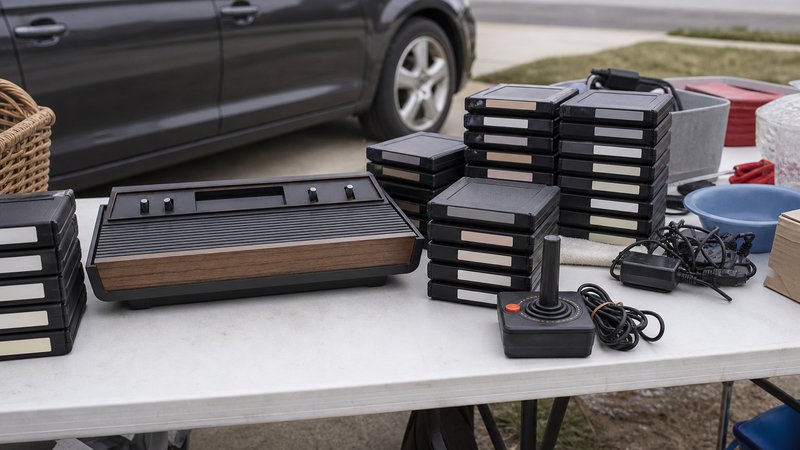
| Original hardware | Everything ever released | Secondhand carts; RF video needs an adapter |
| Activision anthologies | Pitfall, River Raid, Kaboom, H.E.R.O. | Older releases; check current storefronts |
Atari 50 arrived in 2022 from Digital Eclipse, and it treats the catalog as a playable museum rather than a ROM dump. Two expansions landed in 2024, with The First Console War adding 19 games from the Intellivision rivalry. The 2600+ followed in late 2023 as a working replica about 20 percent smaller than the original. It accepts original 2600 and 7800 cartridges and outputs clean HDMI. Current hardware and cartridge listings are published at Atari's official site. Bare ROM downloads of games still under copyright remain the hobby's gray-to-black market. The legal options above now cover most of this list, so that old excuse has thinned considerably.
Is the Atari 2600+ worth buying in 2026?
For anyone with cartridges in a closet, yes. The replica reads original carts, which no software collection can promise, and it connects to any modern TV. For everyone else, Atari 50 delivers far more games for less money. The middle path is a retro handheld, since 2600 emulation is light work for even cheap chips. Collectors chasing boxed cartridges should budget patience, because prices on the classics above keep climbing.
Which of these games should you play first?
Start with Pitfall alone, Warlords with three friends, and Yars' Revenge for pure atmosphere. Those three show the console's whole range in a single afternoon.
From there, follow curiosity by publisher. The Activision catalog rewards players who like precision, and the Atari originals reward players who like ideas. Modern retro handhelds emulate the 2600 easily, and the guide to the best retro gaming handhelds under $100 covers the current hardware. The Man Talk gaming section tracks new retro coverage as it publishes. The about page explains how rankings like this one get made.
Frequently asked questions
What was the first video game Easter egg?
Adventure contains gaming's first famous Easter egg. Atari refused to credit programmers, so Warren Robinett hid a secret room deep in the game. The room displays his name in shimmering text. Players found it after release, Atari left it in, and the industry term Easter egg was born.
How many games were released for the Atari 2600?
Roughly 500 cartridges saw official release during the console's production run, which stretched from 1977 to 1992. Hundreds more came from unlicensed publishers, and modern homebrew developers still release new games today. The console itself sold about 30 million units across that fifteen-year life.
Can you still buy a new Atari 2600 console?
Yes. Atari released the 2600+ in 2023, a working replica about 20 percent smaller than the original woodgrain console. It plays original 2600 and 7800 cartridges on modern televisions over HDMI. Atari also sells new-production cartridges for it, including a Berzerk edition with restored arcade speech.
Why is Pitfall missing from the Atari 50 collection?
Atari 50 only includes games Atari owns, a catalog of 148 titles after the 2024 expansions. Pitfall, River Raid, Kaboom, and H.E.R.O. belong to Activision, which has been a separate company since 1979. Those classics have appeared instead in Activision's own anthology collections over the years.